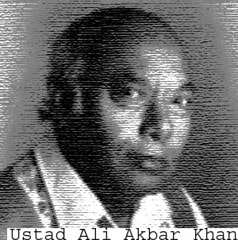
Ustad Ali Akbar Khan

June 21, 2009 12:33 am 0 comments

Ustad Ali Akbar Khan

Hindustani Classical music was traditionally passed down from the maestro to the disciple. This tradition known as the guru-shishya parampara helped nurture some of the greatest artistes. Baba Allauddin Khan (1862-1972) was the court musician of the princely state of Maihar, was the guru whose disciples themselves went on to become musical legends in their own right. “Baba” taught his disciples of the Maihar Band the nuances of Hindustani Classical music as well as Western music tunes. The legendary Maihar Band lost yet another musician yesterday. Ustad Ali Akbar Khan, the sarod player who popularized the complex instrument among Western listeners died on 18 June 2009 at age 87 in California. Ali Akbar Khan was a disciple and son of Baba Allauddin Khan. Watch the video to get a glimpse of Allauddin Khan’s galaxy of disciples from Ravi Shankar, Nikhil Banerjee (Sitar), Ashish Khan, Sharan Rani and son Ali Akbar Khan (Sarod), Pannalal Ghosh (Flute) the list goes on

Ali Akbar Khan’s sister Annapoorna Devi (born Roshanara Khan in 1926 in Maihar) played the surbahar. She married the sitar maestro Pandit Ravi Shankar for a brief period before their divorce. Ali Akbar and Ravi Shankar together made for great brand ambassadors of Hindustani Classical music to be made accessible to the listeners outside of India. I was fortunate to have heard both of them perform at Delhi’s Modern School grounds when they rung in the dawn of a New Year having started playing post dinner on 31st December. The experience of listening to the two legends on the same stage remains a defining moment in my musical journey. Ali Akbar was 13 when he made his debut as a performer at the Allahabad Music Conference in 1936 and accompanied Ravi Shankar during his debut performance at the same conference three years later. Over the years they toured the world together and performed to mesmerize listeners who did not need to to know the alphabet to understand the new language the duo was teaching. Check out this clip of the duo performing.
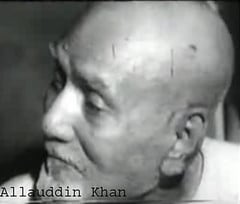
Baba Allauddin Khan

The sarod is a complex instrument with 25 strings.  These include four main strings, four jod strings, two chikari strings and fifteen tarab strings. This fretless instrument is played with a plectrum that is usually made from coconut shell or even the shell of tortoise. Ali Akbar became one of the first names to become synonymous with sarod. He was music director of All India Radio station, Lucknow before leaving it to become the royal musician in the court of the princely state of Jodhpur.

He briefly dabbled with composing music for films much against his father’s wishes. Satyajit Ray invited him to compose the music for his film Devi (1960). Ali Akbar did not think Ray had the same sensibilities in Hindustani Classical as he did for Western. The same year he composed music for Tapan Sinha’s classic Khsudita Pashaan (Hungry Stones), based on a short story by Rabindranath Tagore.

In 1989 he was awarded the Padma Vibhushan, India’s second-highest civilian honor, and in 1991 he became the first Indian musician to receive a MacArthur Foundation “genius grant.” He is credited with the creation of many Ragas. He was not flashy or flamboyant but just a musician who obsessed with his craft. Someone who made the complex instrument communicate in a language that we loved even if we did not understand all of it. Hear Ustad Ali Akbar Khan (April 14, 1922 – June 18, 2009) play Raga Marwa – a Raga that is played at the time of sunset. After all it is the end of an era.


You may also like:

  1. Sarod Less Travelled India is a rare country with two equally well developed traditions of Classical Music - Hindustani (from Northern India) and Carnatic (from South India). This post is about Hindustani Classical music. You have vocalists and instrumentalists to choose from in each category. The classical set of instruments that played solo were traditionally Sitar, Sarod, Bansuri (bamboo flute), Shehnai accompanied by the drone of a Tanpura to keep scale and Sarangi and to the beats of a Tabla. Over the years [...]...
  2. The Charm of Raga Todi There are many beautiful morning ragas in Hindustani Classical music. Raga Todi or Miyan ki Todi was the trademark composition of Miyan Tansen the legendary composer in the court of Akbar. Raga Todi is also known as Miyan ki Todi, Shuddha Todi and Darbari Todi. All these names essentially refer to the same Raga Todi. Todi is a morning raga that is sung from 8am to 10am. It has the ability to evoke the same mood of playfulness of a [...]...
  3. Meeting with Saif Ali Khan It was Friday evening in New York and it seemed that the sky had just been ripped open to pour rain on the cabs scurrying around Manhattan. It is good to be able to spend a weekend in the city. The sights were familiar. I was trying to refresh my memories and was going against the check list in my brain. That’s Port Authority between 8th and 42nd. I used to spend three and a half hours a day commuting [...]...

Leave a Reply


All Recent Articles

  • Featured Interview Management Opinions Recent Articles Building Learning Organizations

    Building Learning Organizations

    Times of India invites practitioners to have a webchat at Timesjobs.com. It was my turn to answer questions on 1st Feb 2012. I wish there was a way to have a “conversation” and not a Q&A. On second thoughts that may be hard to do with 2500 people at the same time. Several people had difficulty signing on and the server was down for a while during the chat. These technical hassles apart, this was fun. Raghavendra: What is a [...]

    Read more →
  • Featured Music Opinions Recent Articles This & That Kailash Kher

    Kailash Kher

    I was at the Kailash Kher concert at the IIM-Bangalore grounds on 29th Jan 2012. This is a fabulous time of the year for music. From October to February as the weather cools down across India, it has been the tradition to get the musicians to strut their wares. This is show time folks. From Indian classical music concerts that start in the evening and end up in the wee hours of the morning, these concerts have seen the launch [...]

    Read more →
  • Books Featured Interview Recent Articles The Ruskin Bond Interview

    The Ruskin Bond Interview

    Ruskin Bond’s first novel, The Room on the Roof, written when he was seventeen, won the John Llewellyn Rhys Memorial Prize in 1957. Since then he has written over 500 short stories, novellas, poems and articles that have appeared in a number of magazines and anthologies. He received the Sahitya Akademi Award in 1993 and the Padma Shri in 1999. His short stories “The Night Train at Deoli”, “Time Stops at Shamli”, and “Our Trees Still Grow in Dehra” have [...]

    Read more →
  • Featured Opinions Recent Articles This & That Coaching Classes for Parents

    Coaching Classes for Parents

    The Bollywood film Taare Zameen Par was perhaps a coaching class that the nation attended, on understanding, how to deal with a kid with dyslexia. It showed us the frustration that parents encounter because of their ignorance of the child’s condition. They believe that their son is plain lazy and is shirking work in school.  The movie brought awareness of learning disabilities and jolted the audience to ask whether they were being just as unreasonable with their children as the [...]

    Read more →
  • Featured Management Opinions Published Recent Articles Being Unreasonable and Impractical

    Being Unreasonable and Impractical

    This is the season for making resolutions. Everyone is making them. As I make up my mind about what resolution I should make, a little voice tells me that in order for me to achieve what I set out to; I must do what is practical and what is realistic. Being practical is defined as “likely to succeed or be effective in real circumstances; feasible.” Being realistic is defined as “expressing an awareness of things as they really are.” The [...]

    Read more →

Switch to our mobile site